
Why information alone is not enough
A folder of documents contains information, but it may not explain which source is current, which rule applies, how a client relates to a contract, when an exception overrides the normal process, or who may approve an action. Service operations need those connections because the same data can produce different decisions in different situations.
Context intelligence turns available information into a decision-ready operating view. It is not a claim that every decision should be automated. It gives a person or system enough grounded context to choose, request review or stop.
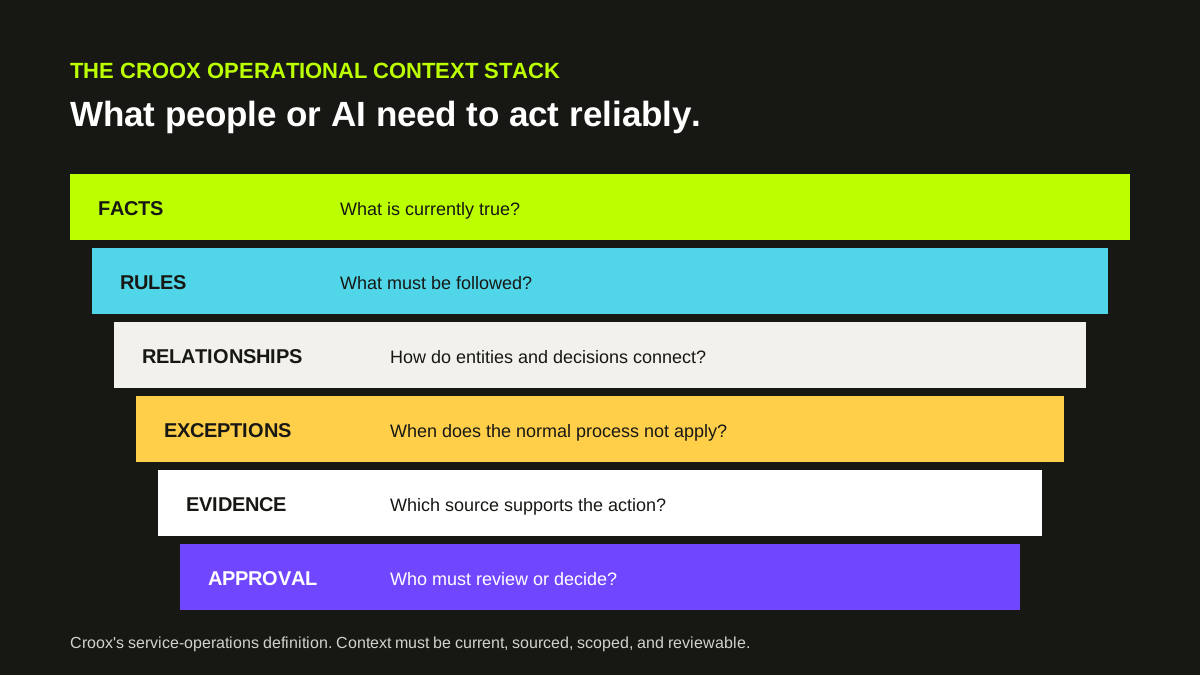
The Croox Operational Context Stack
- Facts: what is currently true about the client, request, work and state.
- Rules: what must be followed, including policy, contract and acceptance criteria.
- Relationships: how clients, projects, documents, owners and decisions connect.
- Exceptions: when the normal path changes and which condition triggers it.
- Evidence: which source supports a fact or recommendation, with freshness and ownership.
- Approval: who may review, override or authorize an action.
Illustrative reporting example
Illustrative example—not a client result. An AI-assisted reporting workflow receives campaign data and a client request. Facts include the reporting period and approved metrics. Rules include the reporting template and prohibited claims. Relationships connect campaigns to the correct client and owner. Exceptions cover missing data or an unusual period. Evidence links each claim to a source. Approval defines which statements require an account lead.
A model with only the raw data may draft fluent text. The context stack determines whether that text belongs to the right client, follows the right rule and is ready to send.
How context is assembled
Start from one workflow and one decision. Identify the minimum facts and rules required for the normal case, then enumerate common exceptions. Attach evidence at the point it supports a decision rather than placing everything into an undifferentiated prompt. Define ownership and freshness for important context.
Context should be retrieved or constructed for the current case. Sending every historical document increases noise and may introduce stale or conflicting instructions.
How to judge context quality
- Can a reviewer trace an important claim to a source?
- Can the workflow detect missing or stale context?
- Are rule conflicts and exceptions explicit?
- Does the context contain only information relevant to the current decision?
- Is there an owner for correction and approval?
Context is an operating asset
Better context can improve human work before AI is introduced. Clear definitions, source ownership, exception handling and approval boundaries reduce avoidable questions and rework. When AI is added, the same operating context supports retrieval, prompt construction, validation and human review.
How to label the evidence
Croox keeps source quality visible so a directional estimate is not mistaken for an audited result. Use these four labels in the working notes and final decision:
When evidence is missing, state the gap and make validation part of the next step. Do not hide uncertainty behind extra decimal places.
Frequently asked
Questions about context intelligence for service operations
Is context intelligence the same as a knowledge base?
No. A knowledge base stores information. Context intelligence selects and connects the facts, rules, exceptions, evidence and approvals relevant to a current workflow decision.
Does Croox claim to have invented context intelligence?
No. Croox uses a specific service-operations definition and the Croox Operational Context Stack to make the concept practical for recurring workflows.
Can context be embedded in one prompt?
Sometimes for a narrow case, but prompts become brittle when context is large, changing or conditional. Retrieval, structured rules and validation may be more appropriate.
Who owns operational context?
Business owners should own meaning and rules; technical systems can store and retrieve them. Important changes need accountable review.
One measurable next step
Move from a useful explanation to a workflow decision.
Bring one recurring workflow, the rough numbers you already have, and the operating problem you want to improve. Croox will separate evidence from assumptions, establish a directional baseline, and identify the smallest useful next step.
Book a Free 20-Minute Workflow Cost Scan