
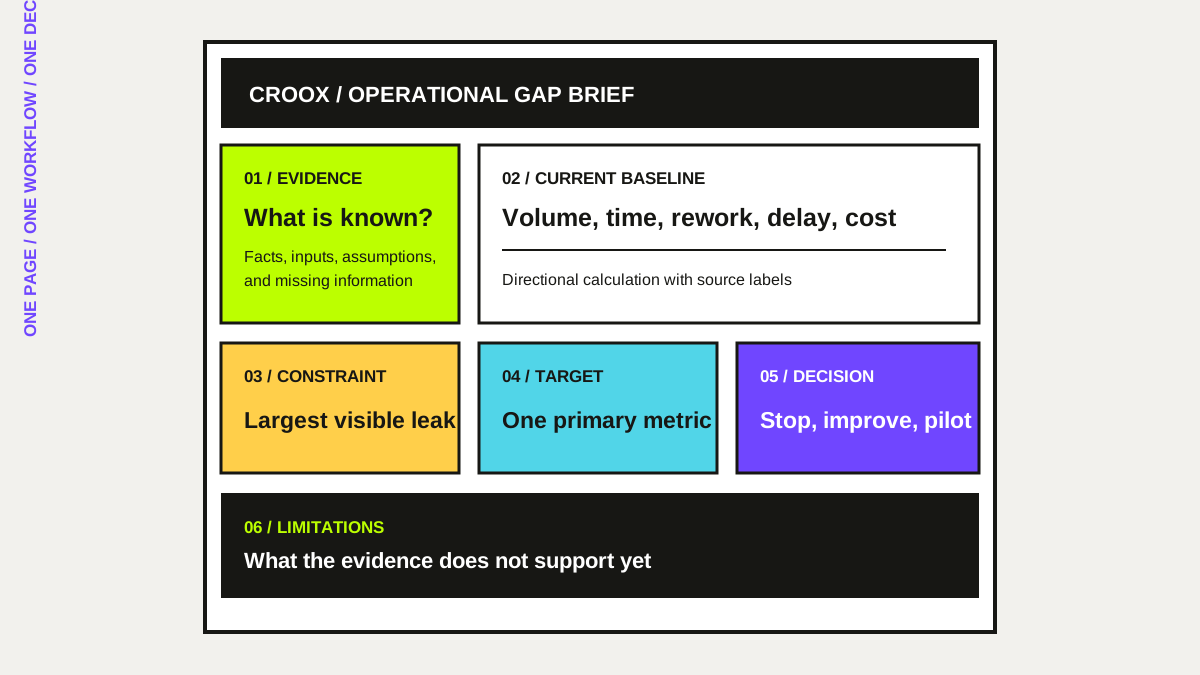
Why one page is useful
Operational discussions often produce a long list of ideas without a decision. A one-page brief forces the analysis to identify the workflow boundary, show the evidence behind the baseline, name the largest visible constraint and choose one target. Detail can sit behind the page, but the management decision remains clear.
The brief is designed for a founder or process owner who needs to decide what happens next, not for presenting a predetermined technology project.
The six parts of the brief
- Evidence: verified information, supplied inputs, hypotheses and gaps.
- Current workflow: trigger, steps, roles, tools, handoffs and output.
- Directional baseline: volume, active time, rework, delay and visible cost.
- Largest visible constraint: the point most likely to consume capacity or slow delivery.
- Target and decision: one metric plus stop, improve or pilot.
- Limitations: what the available evidence cannot support yet.
Evidence labels prevent false certainty
A brief should not present every number with equal confidence. A monthly count exported from a system differs from an owner estimate. A public service description differs from a hypothesis about internal handoffs. Croox labels the source class beside the claim so the reader can see which conclusion is stable and which needs validation.
This makes the brief useful even when the first scan uses directional inputs. Missing evidence becomes part of the recommendation rather than something hidden in fine print.
Illustrative brief decision
Illustrative example—not a client result. A recurring reporting workflow handles 40 outputs per month, uses 54 active hours and waits longest at final review. The baseline is directional because active time is supplied by the process owner. The target is median review turnaround. The recommendation is to clarify approval ownership and measure two cycles before testing draft automation.
The useful decision is not "buy AI." It is "improve the review foundation, measure the target, then reassess the smallest automation candidate."
How to use the brief after the scan
Share it with the people who own the workflow and can challenge the assumptions. Confirm the baseline definition, target, owner and measurement period. If a pilot is justified, use the brief as its starting scope. If the recommendation is to stop or improve first, keep the brief as a record of why.
View the illustrative Croox sample brief to see how evidence and limitations are presented without claiming a client result.
What the brief is not
It is not an audited financial statement, guaranteed savings forecast, complete implementation design or substitute for legal, security or compliance review. A paid project requires a separate scope, access decision, controls and success criteria.
How to label the evidence
Croox keeps source quality visible so a directional estimate is not mistaken for an audited result. Use these four labels in the working notes and final decision:
When evidence is missing, state the gap and make validation part of the next step. Do not hide uncertainty behind extra decimal places.
Frequently asked
Questions about operational gap brief
How long is an Operational Gap Brief?
The core deliverable is one page so the decision remains legible. Supporting calculations or notes can accompany it when needed.
Who should review the brief?
The workflow owner, a person who performs the work, and the founder or decision-maker should challenge the current-state map and assumptions.
Does a brief always recommend a pilot?
No. Stop and improve are valid outcomes. A pilot is recommended only when the evidence supports a measurable, controlled next step.
Can the brief be used by another provider?
Yes. The client keeps the brief and may use Croox, an internal team or another provider for any implementation.
One measurable next step
Move from a useful explanation to a workflow decision.
Bring one recurring workflow, the rough numbers you already have, and the operating problem you want to improve. Croox will separate evidence from assumptions, establish a directional baseline, and identify the smallest useful next step.
Book a Free 20-Minute Workflow Cost Scan