 CROOX
CROOXCurrent-state workflow
The trigger, major steps, owners, systems, handoffs, approvals and output.
This is a summary artifact within a separately agreed paid diagnostic, not a deliverable promised by the free fit conversation. See the complete diagnostic deliverables →
Croox decision artifact
An Operational Gap Brief is a one-page, evidence-labelled summary of a workflow's current baseline, largest visible constraint, recommended target and smallest useful next step. Croox produces it after examining one recurring workflow so a founder can decide whether to stop, improve the foundation or test a pilot.
Open a section to explore the details.
The trigger, major steps, owners, systems, handoffs, approvals and output.
Volume, hands-on time, rework, waiting and visible recurring cost where inputs permit.
The point most likely to consume capacity, slow delivery or create avoidable correction.
One metric and a recommendation to stop, improve the foundation or test a fixed-scope pilot.
Supported by a public primary source.
Provided by the workflow owner and not independently audited.
A possible explanation that needs testing.
A transparent calculation with visible assumptions and limitations.
The public sample uses a Northstar inbound-enquiry workflow and contains no client data or claimed result. It demonstrates the layout, evidence labels, baseline and decision language.
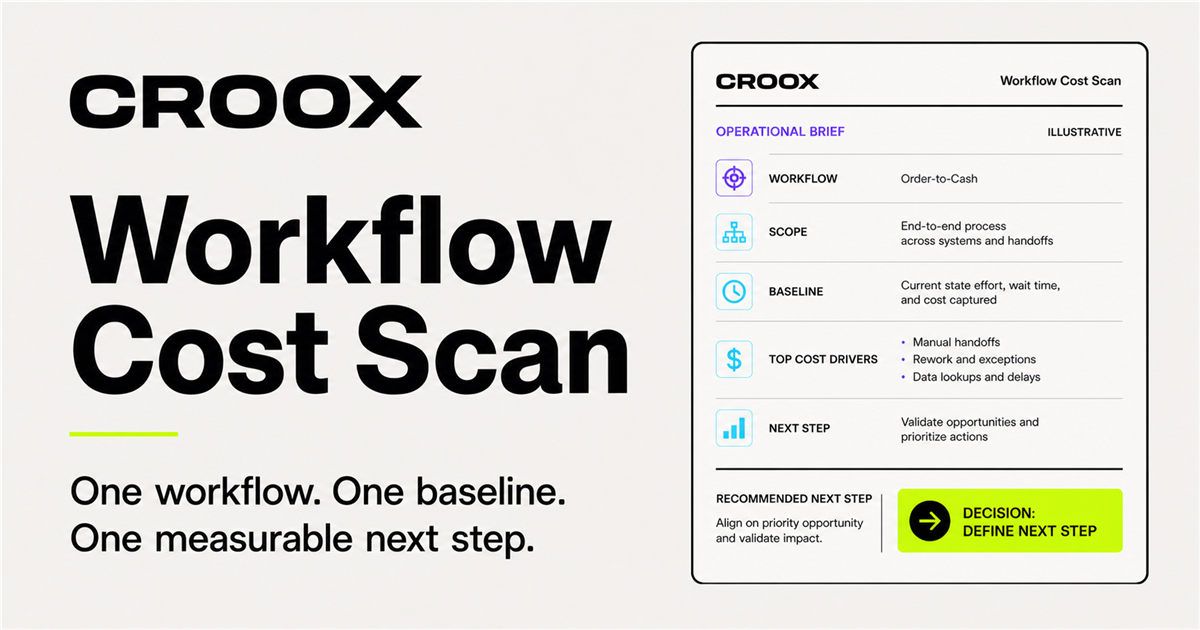
The brief makes the current baseline and target explicit before a build is proposed. A pilot is justified only when the visible constraint is material, the inputs are sufficient, the target can be measured and the scope can be kept small enough to test safely.
The brief is not an audit, guarantee, savings forecast or substitute for detailed implementation discovery. Its quality depends on the available evidence. Waiting time, management overhead, adoption cost and quality impact may remain unmeasured until the agreed diagnostic evidence is available.
Yes. You can use it internally whether Croox, your team or another provider implements the next step.
No. Evidence labels, assumptions, calculations and recommendations receive human review before they are shared.
Yes. Stop or improve-first are valid outcomes.
No. The public sample is explicitly illustrative and contains no client data.